
As generative AI, workflow automation, and enterprise AI applications become increasingly integrated into everyday business operations, enterprises face a new challenge: a single AI solution may not be able to meet requirements for efficiency, cost, data security, and customization at the same time.
As a result, enterprises need to evaluate different AI deployment strategies, including Build, Buy, and Hybrid, based on their specific business needs.
For many organizations, Hybrid AI provides a flexible approach that allows different workloads to be deployed in the most suitable environments across the Cloud, private infrastructure, and the Edge.
A common mistake enterprises make when adopting AI is to look for the latest or most powerful AI tools first, and only then consider how they can be applied. A more effective approach is to start with actual business needs and evaluate three key areas.
Start by identifying repetitive, time-consuming, and highly standardized processes, such as financial report generation, customer service FAQ responses, ticket routing, and initial resume screening.
AI can also support more complex analysis and decision-making. For example, predictive analytics can help optimize supply chain inventory, while customer behavior analysis can help identify potential churn and improve resource allocation.
Tasks involving complex judgment, creativity, emotional communication, and business strategy still require human involvement.
Examples include handling complex customer complaints, coordinating across departments, developing business strategies, and reviewing the accuracy and appropriateness of AI-generated content.
Therefore, enterprises should also consider how responsibilities should be divided between humans and AI when designing AI-enabled workflows.
AI applications require high-quality data as well as infrastructure capable of supporting their computational demands.
When large volumes of data need to move rapidly between storage, memory, and computing resources, data I/O performance can become a critical factor affecting overall AI efficiency.
AI adoption should therefore go beyond model selection and include data governance, computing, memory, storage, and networking in the overall evaluation.
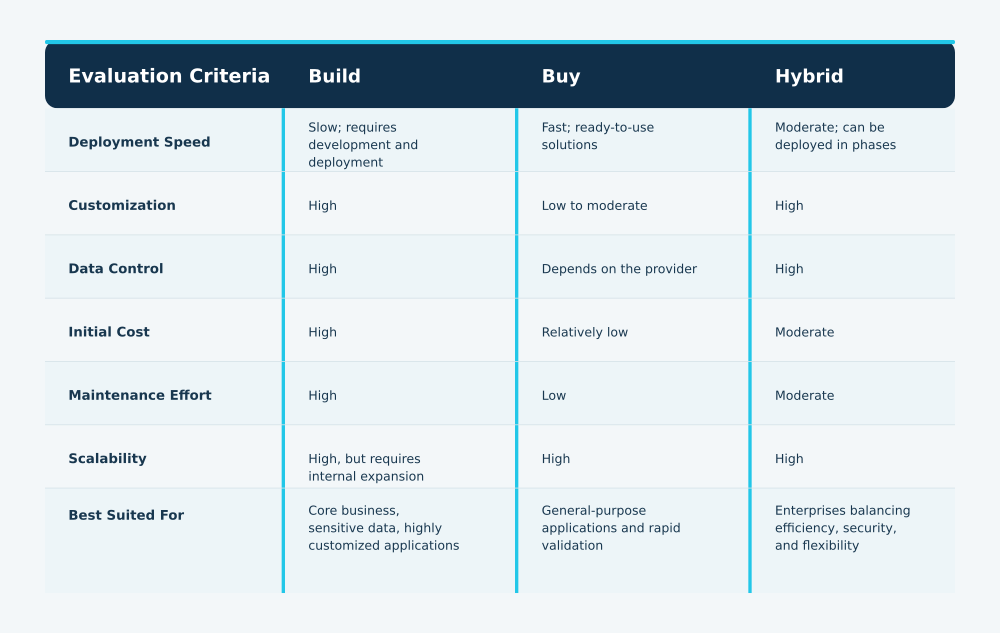
Once the application requirements are clear, enterprises can compare three major AI adoption strategies based on deployment speed, control, cost, and maintenance requirements.
 |
|
Building AI internally is suitable for applications that rely heavily on proprietary enterprise data or require greater control over data security, customization, and system architecture.
However, building AI involves more than developing or selecting an AI model. Enterprises also need to invest in data governance, cybersecurity, model management, and the computing, memory, and storage infrastructure required to support AI workloads.
As a result, the Build approach is generally better suited to larger enterprises with sufficient IT resources and AI capabilities that are closely tied to their core business.
For use cases such as translation, content generation, document processing, and office automation, mature AI SaaS platforms and enterprise solutions can provide a faster path to deployment.
Enterprises can begin with a single department or workflow, measure the results, and determine whether the solution should be expanded.
This approach reduces initial investment and helps enterprises avoid building AI systems without a clearly defined business case.
Enterprises do not necessarily have to choose between Build and Buy.
General-purpose tasks can use mature external AI services, while applications involving sensitive or proprietary data can be deployed within private enterprise environments.
This allows enterprises to determine the most appropriate AI deployment model based on data sensitivity, latency requirements, computational workloads, and cost.
The value of Hybrid AI goes beyond combining internally built and externally purchased solutions. It is also about deploying different AI workloads where they are best suited.
For example, an enterprise can use Cloud AI for general office applications, deploy Private AI or RAG for internal documents and enterprise knowledge, and process time-sensitive device data through Edge AI.
This approach allows enterprises to distribute AI workloads instead of concentrating all data and processing in a single environment.
As AI expands from the Cloud to private enterprise environments and Edge devices, the underlying infrastructure becomes increasingly important.
AI workloads require large volumes of data to move rapidly between storage, memory, and computing resources. Even when GPUs provide powerful computing capabilities, insufficient data delivery can create I/O bottlenecks and limit overall performance.
When designing AI infrastructure, enterprises should therefore consider more than GPUs and CPUs:
AI infrastructure is therefore not simply about adding more computing power. It is about creating a balanced data processing architecture across computing, memory, and storage.
Hybrid AI does not necessarily require a large IT budget.
SMBs can use external SaaS AI tools for general business operations, while applications involving internal knowledge or sensitive data can leverage RAG (Retrieval-Augmented Generation) with open-source models on an on-premises AI workstation or Edge AI device.
For example:
General office tasks → Cloud / SaaS AI
Enterprise knowledge and internal documents → RAG + Private AI
Real-time or sensitive data processing → Edge AI
With this approach, enterprises do not need to build a complete AI system from scratch. Instead, they can gradually develop an AI environment that fits their specific business requirements.
Enterprises do not need to complete their entire AI deployment at once.
A more practical approach is to start small with a clearly defined, repetitive workflow where results can be measured.
Once the application demonstrates tangible business value, enterprises can expand AI adoption to other departments and use cases. As workloads grow, they can also reassess how AI should be distributed across the Cloud, private infrastructure, and the Edge.
Ultimately, successful enterprise AI adoption is not about finding a single “all-in-one” AI solution. It is about building a flexible AI architecture that can adapt to different workloads and business requirements.
From Build and Buy to Hybrid, enterprises need to look beyond the question of “Which AI tool should we use?” and instead ask:
How can we put the right AI, in the right place, for the right workload?
That is the key to moving enterprise AI from tool adoption to real business value.
