
— Robert Lee, Apacer CTO
The rapid advancement of AI has been driven primarily by two key stages: model pre-training and inference. AI models are typically pre-trained through large-scale computing in the cloud or further refined through on-premises training to establish complete and production-ready models.
Once trained, these models are deployed to edge devices to enable real-world applications.
As AI technologies continue to evolve, computing capabilities are gradually shifting from centralized cloud environments to the edge. With the integration of high-performance computing capabilities, edge devices are no longer limited to data collection but are becoming active execution points for AI workloads.
This shift is enabling a wide range of real-world applications. In industrial environments, predictive maintenance has become a key Edge AI use case, where AI models continuously analyze machine sensor data to detect anomalies and prevent unexpected equipment failures.
Edge computing enables devices to process sensor data locally, enhancing operational efficiency.
Edge computing refers to moving data storage, analysis, and computation from centralized cloud platforms to local edge devices, enabling real-time processing without the need to transmit data back and forth between the cloud and on-site systems for sensing and actuation. By executing AI workloads directly on edge devices using AI acceleration units, organizations can significantly improve efficiency, reduce latency, lower network bandwidth consumption, and enhance data security.
In industrial environments, this shift is driving a transition from traditional industrial PCs with single-function processing toward AI-enabled edge computing platforms. By integrating AI accelerators, edge systems become more intelligent and capable of powering advanced applications such as predictive maintenance, where real-time sensor data analysis can prevent costly equipment failures before they occur.
Edge computing enables devices to process sensor data locally and immediately. By deploying trained AI models at the edge, inference results can be generated much closer to the source, reducing response time and operational dependency on the cloud. Real-time data processing relies heavily on algorithm accelerators such as Neural Processing Units (NPUs), which are designed to perform instant computation and inference efficiently.
Realizing these benefits requires careful architectural decisions. Enterprises must ensure that edge platforms are designed for sustained performance, data integrity, and reliability under real-world operating conditions—particularly in industrial environments where power stability, thermal stress, and continuous operation are critical. As Edge AI deployments scale, infrastructure components—including accelerators, memory, and storage—must be selected not only for peak performance, but also for predictable behavior and long-term durability.
High-performance storage is also essential for loading and executing AI models, making SSDs a critical component of edge AI systems.
Apacer’s industrial-grade SSDs featuring SLC-liteX technology are well-suited for edge computing applications. The SLC-liteX algorithm delivers high performance and ultra-low latency for data storage and transmission, while also providing exceptional endurance—making it ideal for AI inference workloads such as KV-cache operations.
Beyond traditional DRAM, modern PCIe SSDs now offer performance levels capable of supporting cache storage for AI workloads. Compared to DRAM, SSDs provide significantly larger capacity, enabling them to store increasingly large AI models and datasets.
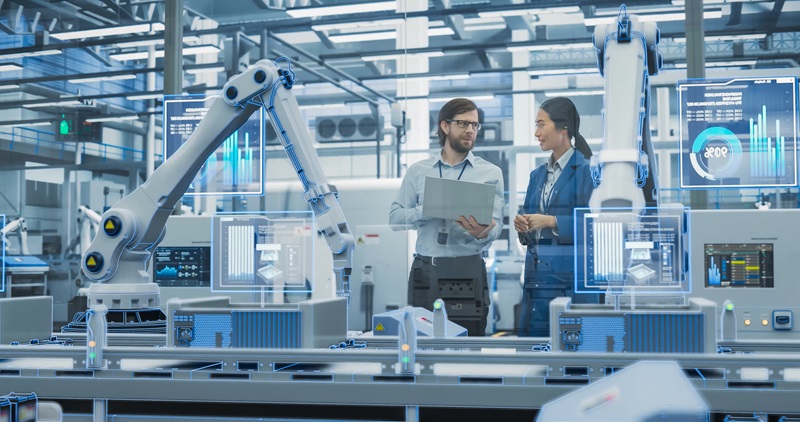
AI enables systems to analyze data and make real-time decisions at the edge.
Today, industrial computers are widely deployed across vertical industries such as manufacturing, transportation, retail analytics, defense, and healthcare. When AI technologies are integrated into these industrial-grade edge devices, artificial intelligence and the Internet of Things become deeply converged. End devices evolve beyond passive sensor data collection and transmission, transforming into intelligent systems capable of autonomous data analysis, prediction, and decision-making.
The realization of AIoT depends on two critical elements: the adoption of AI accelerators such as Neural Processing Units (NPUs), and the deployment of high-performance, high-endurance SSDs. Together, these components deliver more efficient AI inference execution and significantly enhance the overall value of industrial applications.
AI accelerators accelerate inference through optimized internal algorithms and rely on memory as a computation pool at the hardware level. As a result, the integrated use of NPUs, DRAM, and SSD storage is emerging as a key architectural trend for future edge AI systems.
To discover more about Apacer's Success Story